Automotive · Reverse Engineering
Team project
Automotive Dashboard Reverse Engineering
3D Scanning · Rhino · NURBS · Surface Reconstruction
Reverse engineering and reconstruction of incomplete automotive dashboard geometry from 3D scan data using controlled NURBS surface modelling.
Year
2026
Type
Team project
Tools
Artec Leo · Artec Studio · Rhino · NURBS · Zebra analysis
My Role
Surface Reconstruction · Reverse Engineering · CAD Modelling
01 / Overview
The project converted a full vehicle-cabin scan into an editable dashboard model. Artec Leo capture and Artec Studio processing produced a large OBJ reference mesh, which was interpreted and rebuilt as controlled Rhino geometry rather than directly patched.
Problem / Challenge
The source scan contained noise, incomplete edges and large missing dashboard regions. The upper surface lacked reliable orthographic references and crossed several changing curvature directions around the instrument cluster and center console.
Objectives
- 01Preserve the dashboard's dominant styling intent
- 02Reconstruct reliable boundaries and guide curves
- 03Build editable NURBS surfaces from incomplete mesh data
- 04Evaluate joins and highlight flow with geometric and zebra checks
02 / My Contribution
Team project · My contribution is identified below
Within the five-person team, my principal contribution was the missing upper-dashboard and center-transition region. I rebuilt boundaries and guide curves, generated and adjusted the NURBS surfaces, and used zebra analysis to identify remaining local discontinuities. The complete dashboard assembly was a shared team result.
03 / Engineering Process
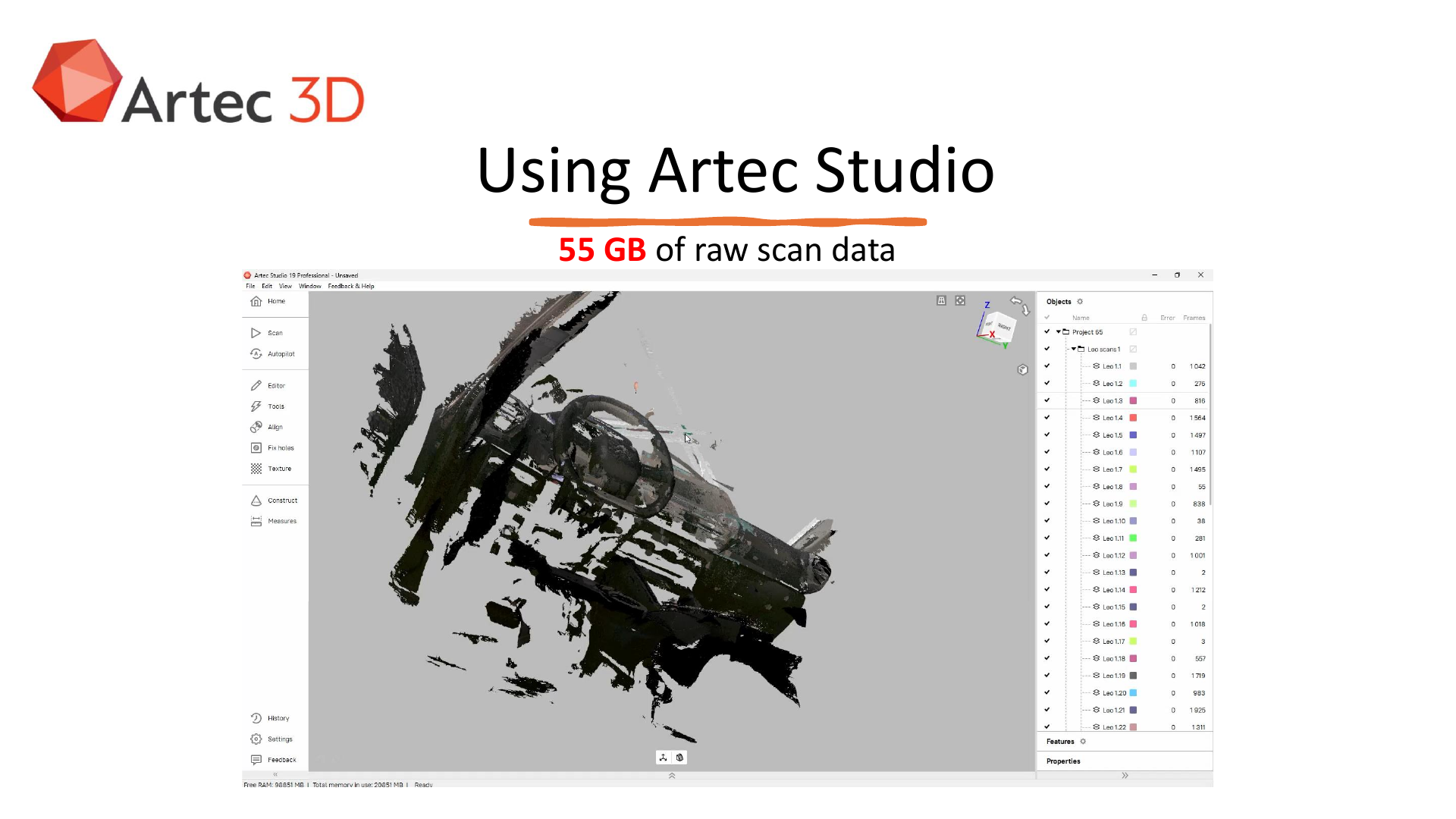
The vehicle cabin was captured with an Artec Leo and processed in Artec Studio, producing approximately 55 GB of raw data and an OBJ mesh. The mesh was assessed for usable reference regions, noise and gaps before the work was divided into dashboard, cluster, center-console, passenger-side and steering-wheel areas.
04 / Technical Development
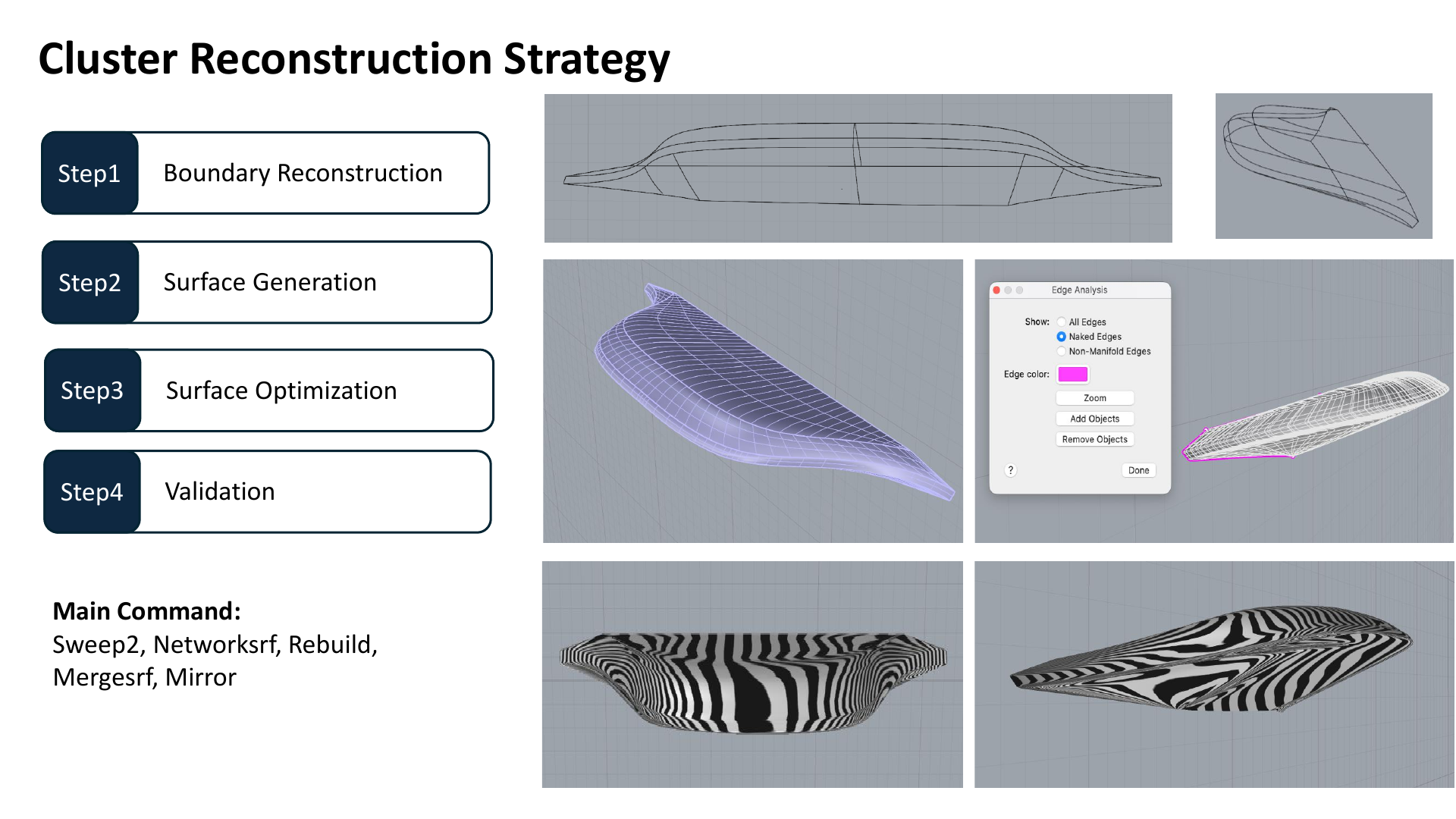
For the large missing upper region, automatic hole filling was rejected because it could not control the styled surface. Boundary curves and guide curves were reconstructed in Rhino, then developed through Sweep2, NetworkSrf, Rebuild and MatchSrf workflows. Local control-point adjustment managed the transition between surfaces with different curvature directions.
05 / Analysis / Validation
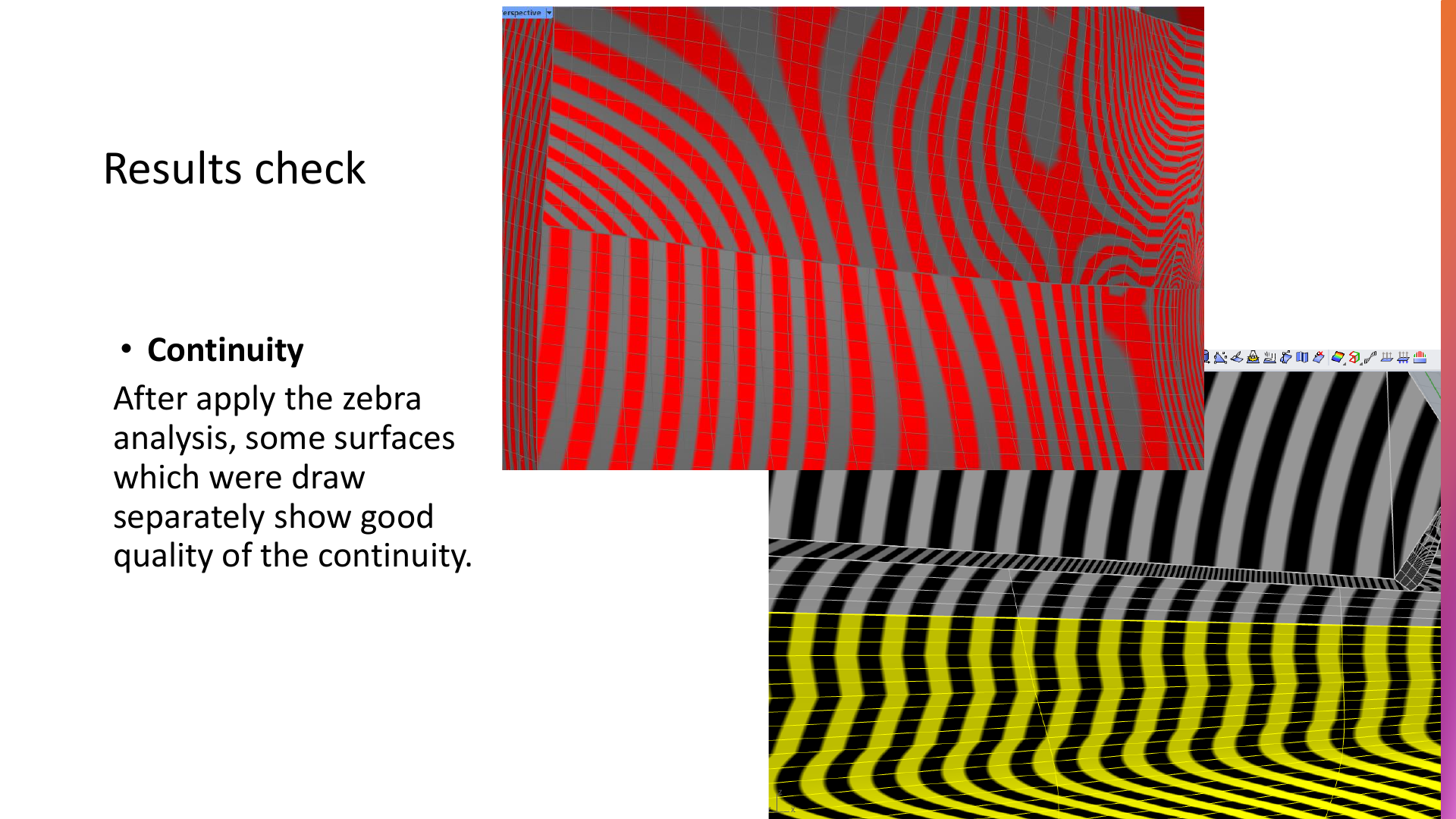
Geometry checks confirmed valid joined polysurfaces and exposed naked or non-manifold edges. Zebra analysis was used to inspect reflection continuity across separately built patches. The overall flow was usable, while local discontinuities remained near the most poorly referenced transitions.
06 / Final Result
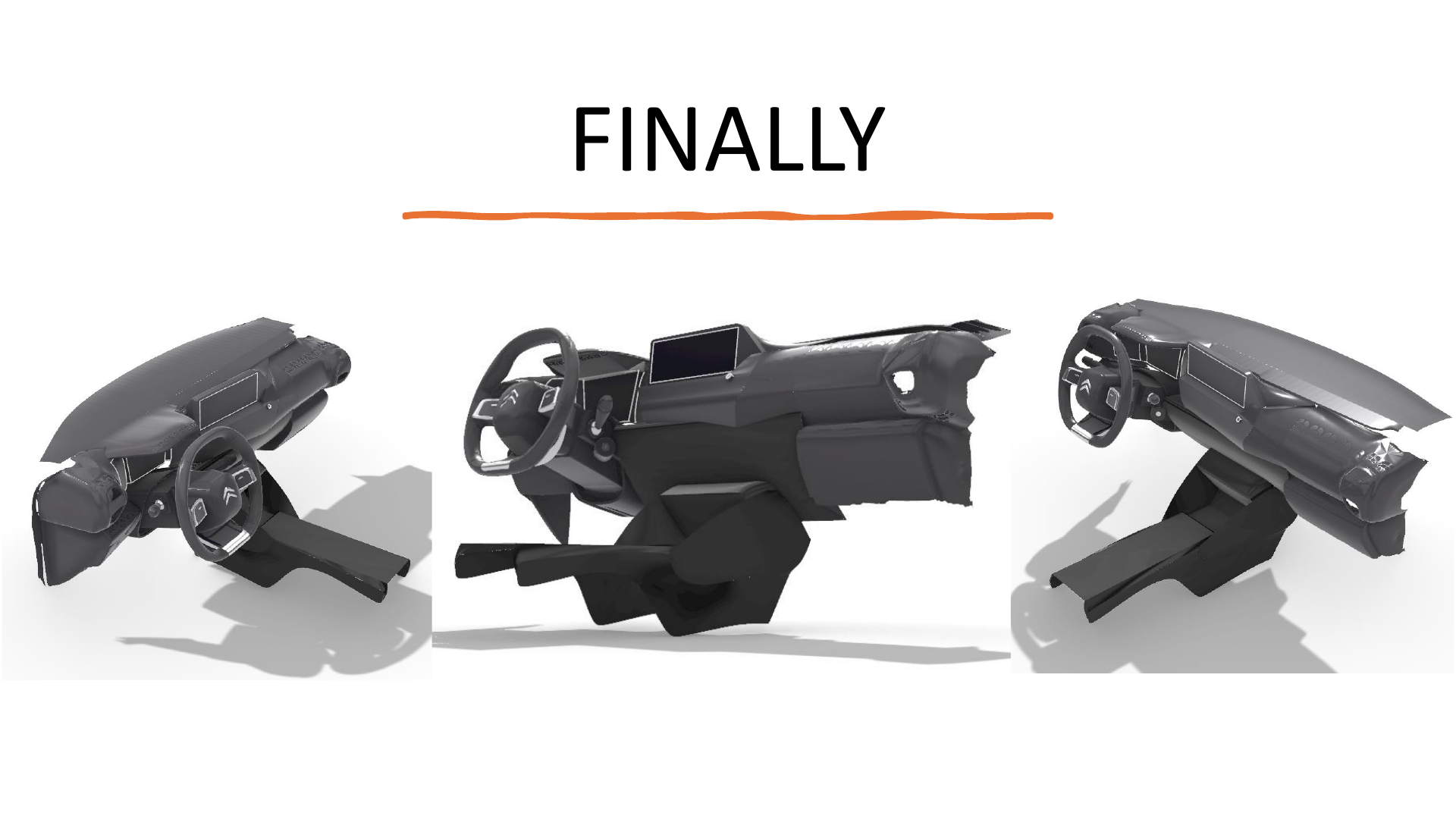
The team produced a complete reconstructed dashboard assembly with editable NURBS geometry. The upper-dashboard contribution transformed a large, incomplete scan region into a controlled surface base suitable for further refinement rather than presenting it as a perfect Class-A result.
07 / Key Learnings
Reverse engineering is an exercise in interpretation, not tracing. A clean result depends on choosing meaningful boundaries, limiting control points, understanding curvature direction and acknowledging where missing source data prevents exact reconstruction.
08 / Tools / Methods
Next Project · 03